
Twenty-one · Decisions · Dealer
Blackjack
In blackjack each hand plays against the dealer and tries to approach 21 without exceeding it. Cards 2–10 count at face value, picture cards count 10 and an ace counts 1 or 11, whichever benefits the hand. Table rules—including blackjack payout, dealer draw, doubling and splitting—materially change expectation.
← All guides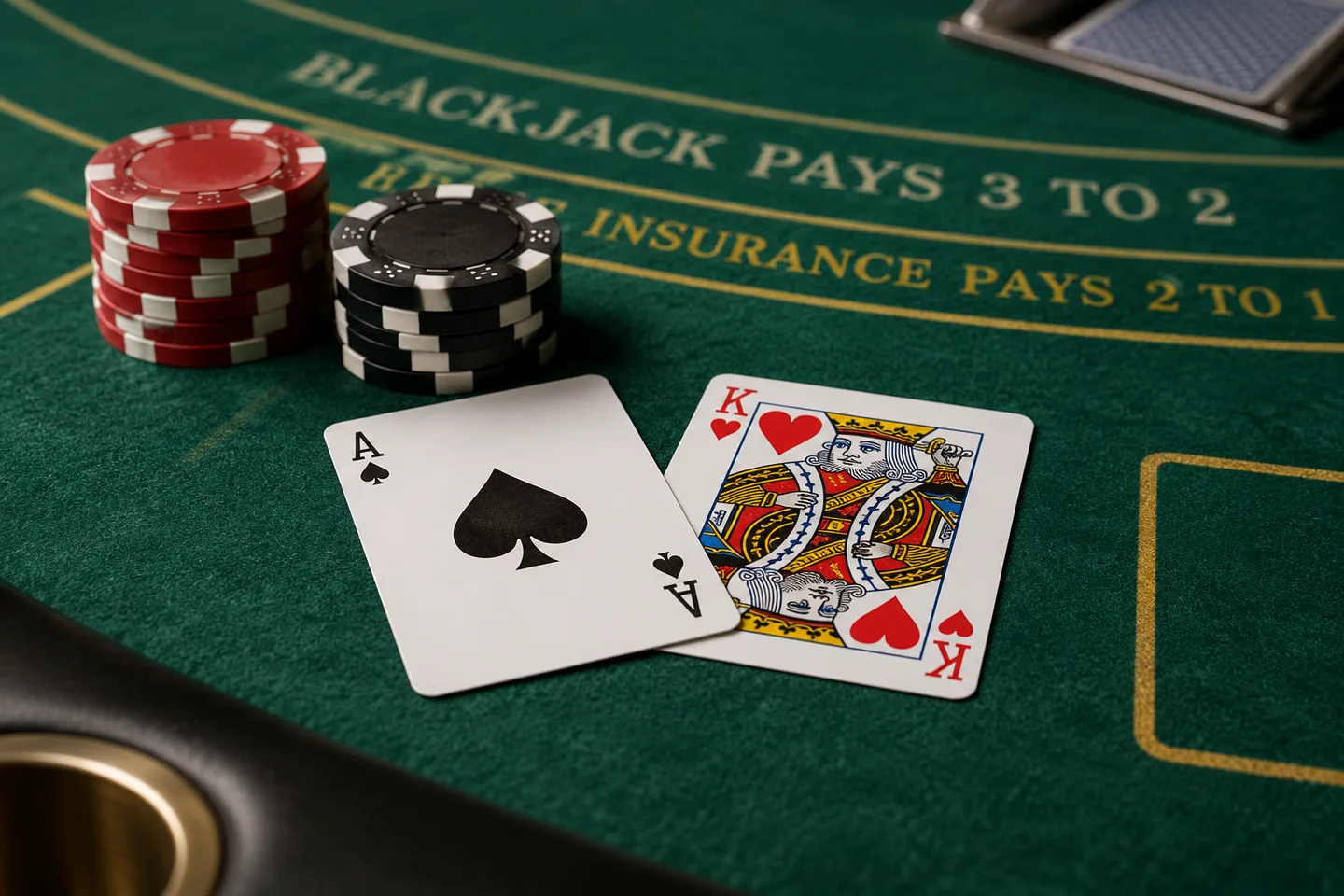
The game at a glance
The game at a glance
Complete sequence of play
Complete sequence of play
- 01
Deal
Player and dealer receive two cards under the variant’s procedure, normally with one dealer card visible. An ace and ten-value card form a natural blackjack, unlike a three-card 21.
- 02
Player action
A player may hit, stand, sometimes double the bet for exactly one more card, or split a pair into two hands. The table must state which options are available.
- 03
Dealer action
After the players, the dealer reveals the hole card and draws automatically. The dealer normally hits below 17; some tables require a hit on soft 17, changing the house edge.
- 04
Settlement
A total over 21 loses immediately. Otherwise a total above the dealer wins even money, a tie pushes and a natural blackjack receives the posted payout.
Reference table
Card values
| Card | Value | Note |
|---|---|---|
| 2 to 9 | Face value | Fixed |
| 10, jack, queen, king | 10 | All equivalent |
| Ace | 1 or 11 | Best value without busting |
| Ace + ten-value card | Blackjack | Only as the first two cards |
Understand before staking
Understand before staking
Natural blackjack and payout
A natural blackjack normally beats any 21 made with more than two cards. Traditional 3-to-2 payment is better than 6-to-5: a £10 stake wins £15 or £12 respectively, before returning the stake. This one line materially changes long-run cost. Also check whether the dealer checks immediately for blackjack under an ace or ten.
Doubling and splitting
Doubling adds an equal stake and usually gives one card only; splitting creates two hands and requires another stake. Rules may restrict double-after-split, resplits or split aces. Insurance, offered against a dealer ace, is a separate bet that the dealer has blackjack and normally carries a comparatively high house edge.
Basic strategy and counting
Basic strategy maps the player hand and dealer up-card to the table’s exact rules. It reduces avoidable mistakes but never guarantees profit. Counting does not predict the next card, and frequent or continuous shuffling reduces its practical effect. Betting progressions do not change draw probabilities.
Read the table first
Check deck count, blackjack payout, soft-17 rule, doubling, surrender and limits. Side bets such as Perfect Pairs or 21+3 use separate paytables and commonly carry a higher edge. Visual prominence does not make them part of the main hand or improve their value.
Official sources to consult
These references cover the jurisdiction stated in their titles. Applicable rules, variants and payouts remain those of the specific game and jurisdiction.
Worked example · Explicit assumptions
Compare 3:2 and 6:5
On a €10 stake, a blackjack paying 3:2 earns €15 profit; 6:5 earns €12. Including the returned stake, gross returns are €25 and €22. This is the blackjack payout, not every winning hand.
Deck count, dealer rules, doubling and splitting also matter. A single payout cannot establish the overall house edge.
Understand and check the calculationsCheck understanding · Explicit assumptions
Doubling: how much is exposed?
Assume a €10 stake doubled by another €10, followed by an ordinary even-money win. What is the gross return?
Show the calculation and its limits
Total stake: €20. Profit is €20 and gross return including the returned stake is €40. A loss costs €20. Doubling raises exposure; read its permitted conditions.
FAQ
Frequently asked questions
What is the basic principle of Blackjack?
In blackjack each hand plays against the dealer and tries to approach 21 without exceeding it. Cards 2–10 count at face value, picture cards count 10 and an ace counts 1 or 11, whichever benefits the hand. Table rules—including blackjack payout, dealer draw, doubling and splitting—materially change expectation.
Which rules should I check before playing Blackjack?
Player and dealer receive two cards under the variant’s procedure, normally with one dealer card visible. An ace and ten-value card form a natural blackjack, unlike a three-card 21. Also check the exact variant, payment table, stake and session cost before playing.
Does understanding Blackjack make it profitable?
No. Understanding the rules helps prevent mistakes but does not remove chance, costs or the house edge.