Reels · Paytable · RNG
Slot machines rules: play, payouts and risk
A slot converts a stake into a random result under its mathematical configuration. Symbols, paylines, ways, wilds and bonuses only make sense alongside the exact version’s paytable. In a certified game the random-number generator determines the outcome; the reel animation displays it and is not a skill phase.
Estimated reading time: 6 min
← All guides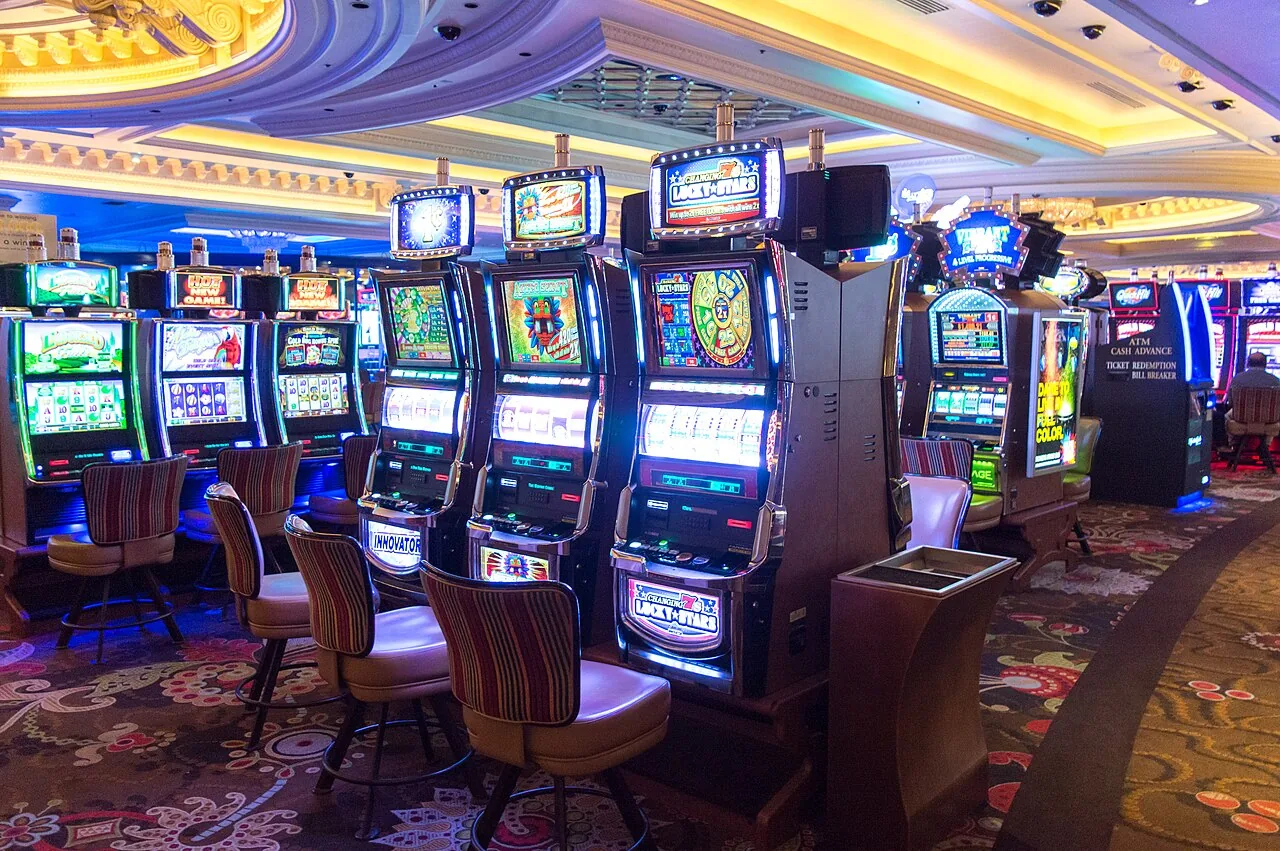
The game at a glance
The game at a glance



Complete sequence of play
Complete sequence of play
- 01
Set the stake
Total stake may depend on coin value, active lines or an overall level. Changing it can also change eligibility for a jackpot or feature.
- 02
Start a spin
One press triggers an outcome. On a properly tested regulated system, manually stopping reels does not improve symbols already determined.
- 03
Read combinations
The paytable states direction, required symbols, multipliers and wild behaviour. A visible symbol outside an active line or combination may pay nothing.
- 04
Feature and payment
Scatters, free spins and special features follow separate rules. Winnings are credited and become another stake only if the player chooses to rebet them.
Reference table
Reading the help screen
| Item | What it states | Useful question |
|---|---|---|
| Total stake | Real spin cost | Are all lines active? |
| Paytable | Combinations and awards | Is the award multiplied by stake? |
| RTP | Theoretical long-run return | Is this the current configuration? |
| Volatility | Size of fluctuations | How does the provider define it? |
| Feature | Trigger and rules | Is a minimum stake required? |
Understand before staking
Understand before staking
Paylines, ways and clusters
A payline requires symbols along a stated path, often starting on the first reel. Ways games pay adjacent matching symbols without fixed paths; cluster games require connected groups. A large advertised number of ways cannot compare value across games without frequency, award sizes and total stake.
RTP and volatility
RTP is a theoretical configuration average over an enormous number of spins. A 96% RTP does not promise £96 after £100 staked. Volatility describes dispersion: a volatile game tends to pay less often but sometimes more. Visually identical versions can carry different RTP settings, so check the help screen for the version in use.
Jackpots and features
A progressive jackpot funds a pot that changes with play, and eligibility may require a particular stake. Free spins remain gambling rounds and their value is included in the maths. A near miss or two bonus symbols does not make the missing third symbol more likely on the next spin.
Speed and cumulative cost
A small unit stake can hide hourly expenditure. At £0.50 a spin, 300 spins represent £150 in gross stakes even where interim wins are recycled. The meaningful personal figure is all deposits minus all withdrawals together with time spent, not the dramatic total-win counter.
Official sources to consult
These references cover the jurisdiction stated in their titles. Applicable rules, variants and payouts remain those of the specific game and jurisdiction.
Worked example · Explicit assumptions
Turnover changes theoretical cost
A hypothetical 500 spins at €0.50 creates €250 turnover. At 96% theoretical RTP, expected loss is 250 × 0.04 = €10. Doubling speed for the same duration doubles expected cost if everything else stays equal.
€10 is neither a maximum loss nor a guaranteed session result. Replaying returns may create turnover larger than the deposit.
Understand and check the calculationsCheck understanding · Explicit assumptions
Small stakes, larger turnover
Hypothetical 200 spins at €0.20. What is the cumulative stake even if the account received only a €10 deposit?
Show the calculation and its limits
200 × 0.20 = €40 staked. Returns may have been replayed; deposits and turnover differ. Net loss needs balances, deposits and withdrawals, not turnover alone.
Probability and payout
Same RTP, very different outcomes
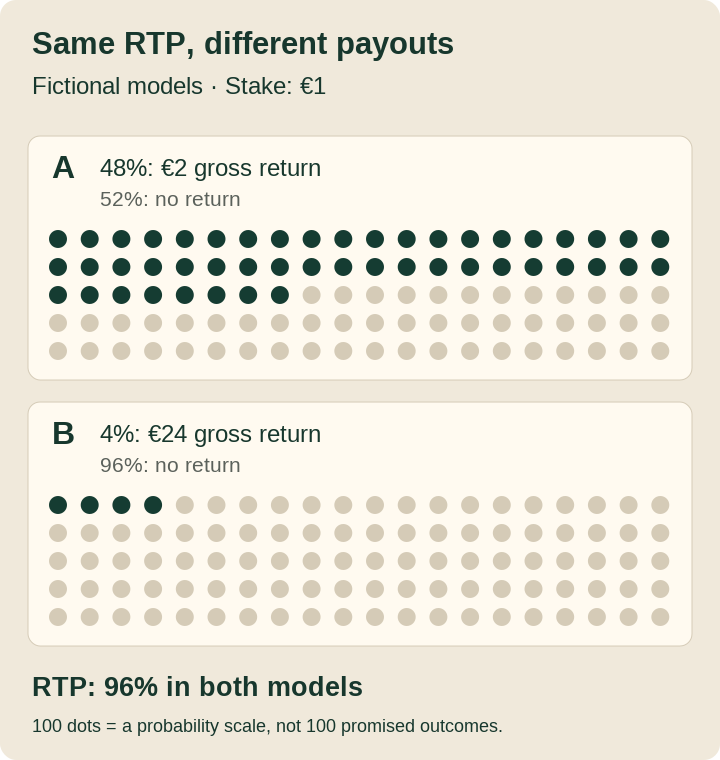
Two fictional models with two outcomes and a €1 stake per draw. These are not existing machines. Probabilities are assumptions chosen for the calculation, not observed frequencies.
| Model | Possible gross return | Probability | Calculated RTP |
|---|---|---|---|
| A | 2 € / 0 € | 48 % / 52 % | 96 % |
| B | 24 € / 0 € | 4 % / 96 % | 96 % |
48% × €2 = €0.96; 4% × €24 = €0.96. In both models, the theoretical mean return is 96% of the stake and the mean net result is −€0.04 per draw. Yet the probability of losing the whole stake is 52% in A and 96% in B.
RTP alone therefore describes neither payout frequency nor dispersion. The dots illustrate probabilities, not a guaranteed sequence of 100 games. Repeated stakes increase money exposed and guarantee no personal return.
Compare other assumptionsFAQ
Frequently asked questions
What is the basic principle of Slot machines?
A slot converts a stake into a random result under its mathematical configuration. Symbols, paylines, ways, wilds and bonuses only make sense alongside the exact version’s paytable. In a certified game the random-number generator determines the outcome; the reel animation displays it and is not a skill phase.
Which rules should I check before playing Slot machines?
Total stake may depend on coin value, active lines or an overall level. Changing it can also change eligibility for a jackpot or feature. Also check the exact variant, payment table, stake and session cost before playing.
Does understanding Slot machines make it profitable?
No. Understanding the rules helps prevent mistakes but does not remove chance, costs or the house edge.
WORLD GAMBLING GUIDE